
From Brandon Martini
Two Mouton-Rothschilds on One List: 2013 vs. 2019
October 19, 2026
At the very end of the red section on our wine list, the two priciest bottles we carry sit one on top of the other. Château Mouton-Rothschild 2013, $1,900. Château Mouton-Rothschild 2019, $2,400. Same estate, same village of Pauillac, six years apart. The 2013 comes from a cool, wet year and should be the more open, savory wine to drink tonight. The 2019 comes from a warm, dry summer and is riper, more concentrated, and still young. Ripe years like 2019 usually trade higher than difficult ones like 2013, and on our list the gap is $500.
Neither has a 3-ounce or 6-ounce price next to it. They're bottles, and they make a good case study.
Why do two vintages of one wine make a good lesson?
Because almost everything is held steady. The estate, the vineyards, the village, and the house style don't change from one bottle to the other; the year does. Whatever differs between them is mostly what the weather did.
That's a rare thing to be able to point at on a single page. Most lists, ours included, show you one vintage of a wine and leave you to imagine the rest.
What does "First Growth" actually mean?
It's a ranking that dates back to 1855, when Bordeaux sorted its leading red-wine châteaux, almost all of them in the Médoc, into five tiers called growths. First Growth is the top tier, and today it has five members. Three of them are in Pauillac, and Mouton is one of the three.
Mouton has an unusual place in that story. It was ranked a Second Growth in 1855 and raised to First Growth in 1973, the one time the top tier has changed. I like that detail, because it's a reminder the ranking is a judgment people made, not a law of nature. It describes châteaux and their long track records. It doesn't promise anything about a given bottle, which is exactly why the year on the label matters.
What kind of wine is it?
Pauillac sits on Bordeaux's Left Bank, where Cabernet Sauvignon does the heavy lifting, and Mouton is built mostly on it. In plain terms: dark fruit, firm tannin, and a structure meant to last for decades rather than months.
Mouton also commissions a different artist to illustrate each vintage's label, a tradition going back to 1945. So the 2013 and the 2019 don't even look alike on the table.
Why is the 2013 $500 less?
The year. 2013 was a cool, wet, difficult season across Bordeaux; 2019 had a warm, dry summer. Ripe vintages like 2019 usually trade higher, and our list follows the market.
I wouldn't call the 2013 the lesser wine, though. A difficult year at a serious estate tends to produce something lighter and more forward, not something failed. It's now thirteen years past its harvest, and for a wine from a lighter vintage that's time well spent. The tannin should have softened, and what I'd expect to find is a more savory, open wine than it was in its youth. If you're ordering a Mouton to drink with dinner rather than to admire, I'd look hard at the 2013 first.
The 2019 is the other side of the coin. Seven years from vintage, a ripe Pauillac is usually still young: more fruit, more concentration, tannin that hasn't relaxed yet. Pour it slowly and let it change in the glass over the meal. The last glass will likely be the most open. It's the bottle for someone who wants to see what Mouton looks like from a year that had everything going for it.
What should I eat with either one?
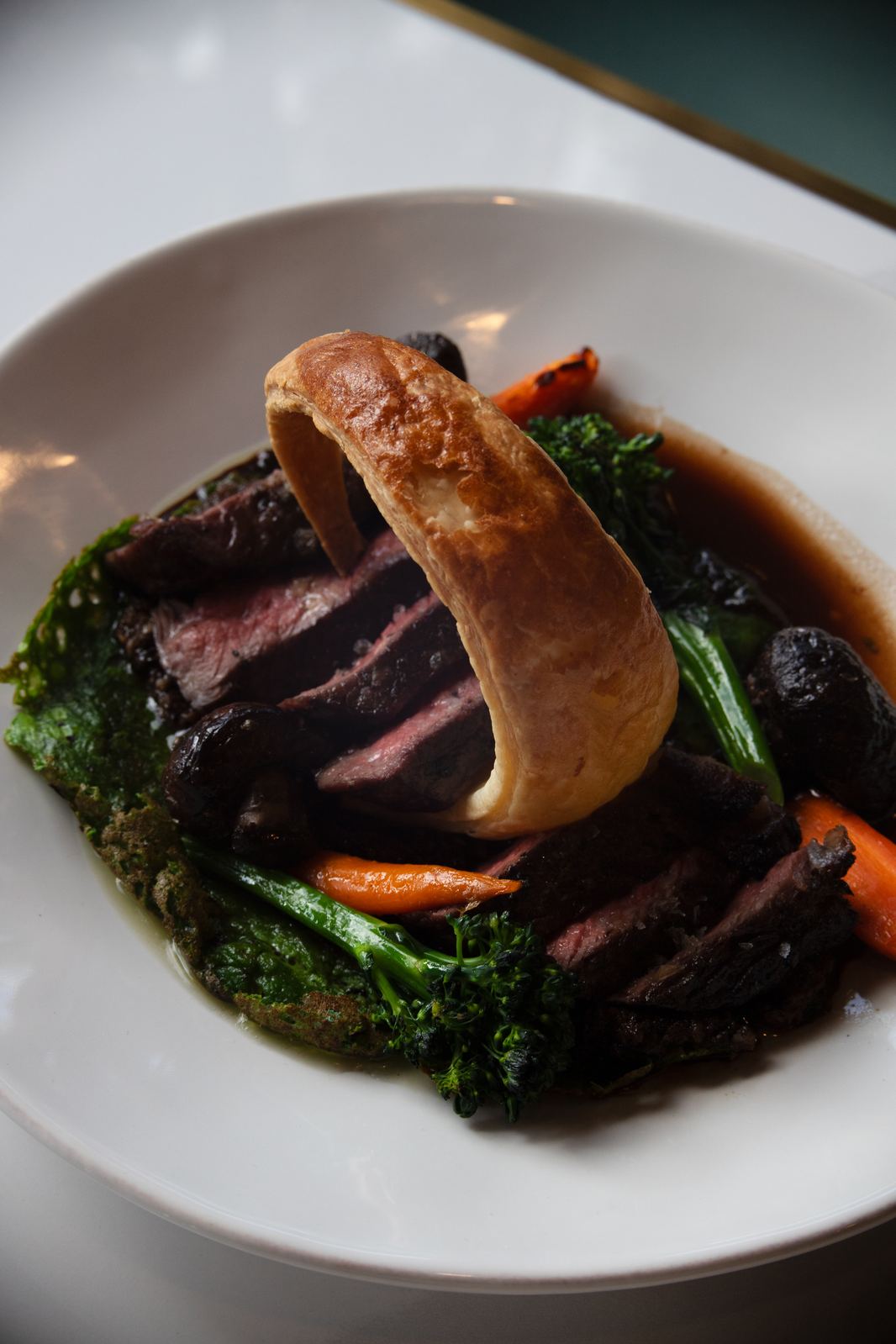
Beef, and the simpler the better. From our dinner menu I'd point you to The Hangar ($39), DemKota Ranch sirloin with cipollini onions, or Flaps Down ($41), the slow-braised chuck flap with butternut mashed potatoes. Tannin and protein soften each other, which is why Cabernet and beef keep ending up at the same table.
Can I taste Mouton without buying the bottle?
There's no listed pour for either one. The house rule printed at the bottom of our list says a single glass may be poured from any bottle for half the bottle price, so a glass works out to $950 for the 2013 or $1,200 for the 2019.
If what you really want is to taste the neighborhood, there are friendlier ways in. The Aspirant de Beychevelle 2018 comes from Saint-Julien, the village just south of Pauillac, at $105 a bottle. The Chateau Mongravey Margaux is $80. And for a contrast across the river, the Vieux Maillet Pomerol is Right Bank Merlot that we pour by Coravin, $26 for three ounces. Tasting it next to a Left Bank red teaches the same kind of lesson as the two Moutons at a much smaller scale, which is the whole idea behind our 3-ounce pours.
Will both vintages always be there?
I can't promise that. Vintages on our list can change without notice, and these two aren't easy to replace. The wine list on our menu page shows what's on it right now.
If you'd like to look through the list with some time on your hands, reservations are open. Order a Mouton or a 3-ounce pour; either way, I'm happy to talk Bordeaux.
Does Solera serve Château Mouton-Rothschild by the glass?
Only under the house half-bottle rule. Neither vintage has a listed 3-ounce or 6-ounce pour; Solera lists Château Mouton-Rothschild 2013 at $1,900 and 2019 at $2,400 by the bottle. The printed rule allows a single glass from any bottle at half the bottle price, which works out to $950 for the 2013 or $1,200 for the 2019.
Why is the 2013 Mouton-Rothschild less expensive than the 2019?
Vintage. 2013 was a cool, wet, difficult growing year in Bordeaux, while 2019 had a warm, dry summer, and ripe vintages generally command more than difficult ones. On Solera's list the gap is $500: $1,900 for the 2013 and $2,400 for the 2019.
Join the Solera list
Get on our list for updates on events and our restaurant