From Brandon Martini
Why Mary’s Organic Chicken and Duck Are All Over Our Menu
November 23, 2026
The box says Mary's Organic. So do five lines of our all-day menu in Seal Beach.
Those five lines are Rowan's Chicken Croquettes, the Speedbird, Pecking Through the Orchard, Quack Quack, and The Wohrman Duck Reserve, and every bird in them comes from the same California poultry producer. Most of the questions we get at the bar are about the wine list. This is the answer to one I'd like to get more often.
What is Mary's Organic?
Mary's is a poultry producer in California, and Mary's Organic is its certified organic line. Organic, on a bird, is a regulated word in this country: certified organic feed, no antibiotics, access to the outdoors. That's the part that matters in a kitchen. I'll leave the rest of the farm story to the people who run the farm, because what I can speak to is what happens once the birds reach Chef Michael Droma's kitchen.
I'm biased, but I think the difference shows up on the plate. The skin crisps the way skin should, and the leg meat has enough character to stand up to a long braise. Duck is a different argument. It's mostly about fat, so it needs a bird raised with some.
Why one producer for five dishes?
My read, from the dining-room side of the pass: a kitchen is a set of habits, and a bird you cook every night is a bird you learn. The other reason, and this one I can read straight off the menu, is that one standard lets Michael cook the whole animal. Legs and breasts want opposite treatment, and when every bird is the same bird, the kitchen can build a dish around each part instead of around whatever came in that week.
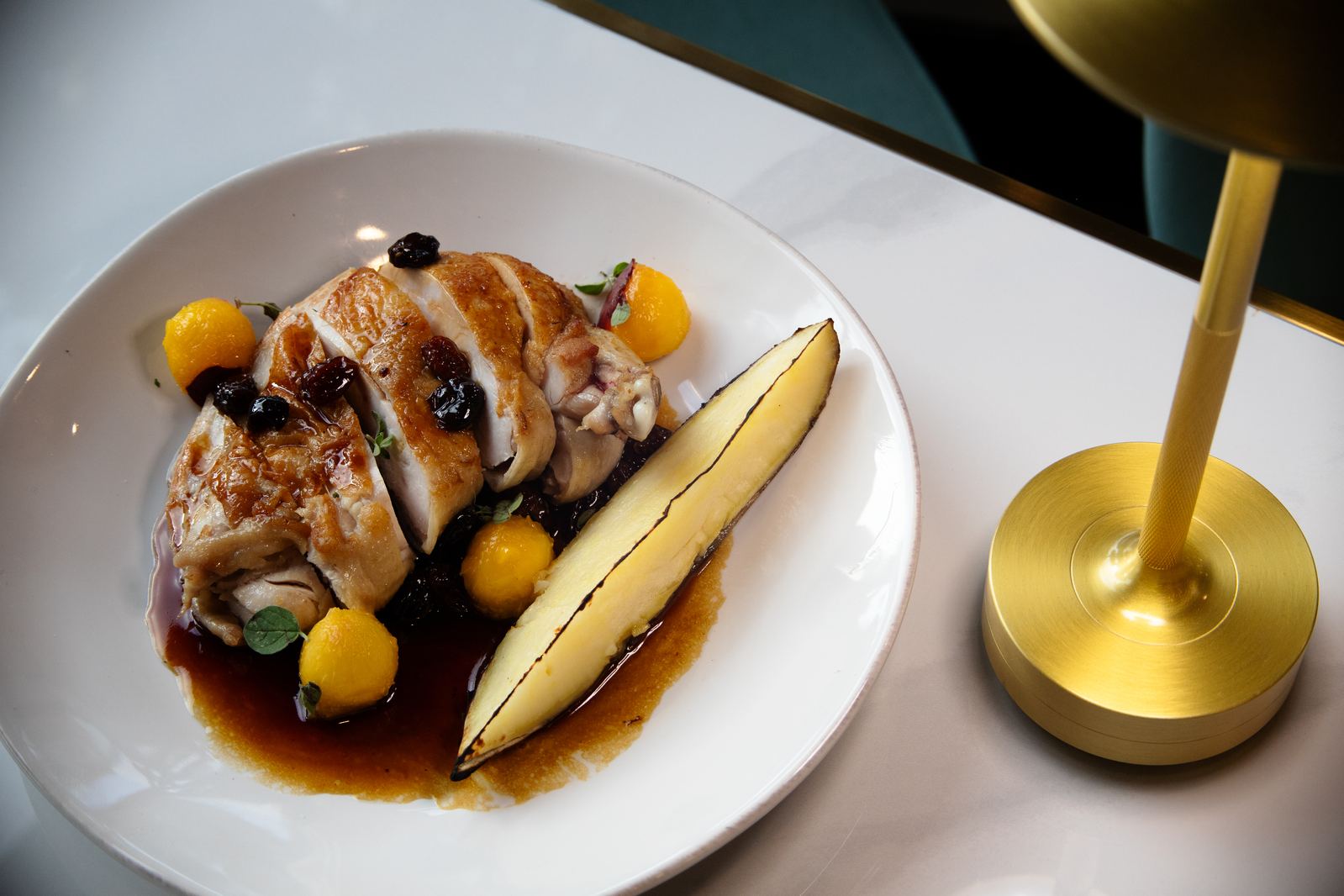
Here's what learning a bird means in practice. A half chicken goes in skin side down. The skin has to render before it browns, and how long that takes is a property of the bird, not the cook. Swap the bird and the line is guessing again. Skin that tears. Skin that browns before it crisps. A breast that's done while the thigh wants five more minutes. Cook the same bird for a season and nobody has to think about it anymore, which frees the line to think about everything else on the plate. The dish is Pecking Through the Orchard ($33), the pan-seared half chicken with the cranberry rosemary gastrique, sweet potatoes, and apricots in the photo above. A gastrique is sugar cooked to caramel and cut with vinegar, sweet and sharp at once, and it's the dish I'd use to judge any kitchen's chicken, ours included.
The breast is a harder test than the half bird, not an easier one. The Speedbird ($26) is a roasted Mary's Organic chicken breast on frisée with lemon, capers, and a Dijon vinaigrette, and there's nothing on that plate to hide behind. Lemon, capers, and a vinaigrette are not going to cover for a dry breast, so a dry breast shows. It's the dish on our menu that depends most on the producer, and it's on the menu because I trust the bird. It's also on the table alongside brunch on Saturday and Sunday, since the all-day menu runs through brunch hours.
The leg goes the other way entirely. Legs are the part of a chicken with the most flavor and the most patience, so the kitchen gives them time instead of heat. Braised until it shreds, the Mary's Organic chicken leg becomes Rowan's Chicken Croquettes ($17): three of them, braised leg and béchamel under a crisp breadcrumb crust, with a charred paprika purée and cilantro.
Why does duck need a fat bird?
Everything good about duck is in the fat, and there's a layer of it under the skin of the breast thicker than anything on a chicken. Searing a duck breast is mostly the business of rendering that layer down until what's left is thin and crackling while the meat underneath stays tender. On a lean bird there isn't enough fat to render and the skin goes leathery instead. On our menu that bird is The Wohrman Duck Reserve ($38), seared Mary's Organic duck breast over Isabella rojo mole with a tamarind glaze and braised fennel. Yes, that Wohrman: Todd is the other half of this place.
Confit is the oldest trick for a duck leg: cook it slowly in fat until it gives up entirely, then crisp the skin. On the menu it's Quack Quack ($28), slow-cooked Mary's Organic duck leg confit with crackling-crisp skin, fried herb butter peewee potatoes, and a yuzu dressing. Yuzu, a sour Japanese citrus, cuts through all that richness. If you've never ordered duck because it sounds like a project, start here.
Chicken pairs with almost anything. Duck is more fun. The gastrique on the half chicken and the mole on the duck pull in different directions, so tell your server which bird you ordered and let them pick the glass. We pour three-ounce tastes so you can try it against the plate before you commit. All five dishes are on the menu every day we're open.
If you want to taste what one producer buys a kitchen, order the Speedbird and the Quack Quack at the same table and pass the plates. We're on Main Street every day, and a table on SevenRooms is there if you want one.
Which dishes at Solera use Mary's Organic chicken or duck?
Five dishes on the all-day menu name the producer: Rowan's Chicken Croquettes ($17), the Speedbird ($26), Pecking Through the Orchard ($33), Quack Quack ($28), and The Wohrman Duck Reserve ($38). The chicken dishes use the leg, the breast, and the half bird; the duck dishes use the leg confit and the breast.
What does organic mean on a chicken?
In the United States, organic is a regulated label for poultry: the birds are raised on certified organic feed, without antibiotics, with access to the outdoors. Mary's Organic is the certified organic line from Mary's, a California poultry producer.
Join the Solera list
Get on our list for updates on events and our restaurant